Wednesday, August 30, 2017

How to Get Unstuck and Build Your Online Business – Jason van Orden

Episode: 305
Who: Jason van Orden
Website/Blog: JasonVanOrden.com

Do you ever feel stuck or dissatisfied with your business?

Are you feeling like you need a change, but you’re not sure where to start?

Today, I’m talking to Jason van Orden, who has worked with more than 6,000 students and clients over the past twelve years, teaching them about how to monetize their unique brilliance with content marketing, scalable courses, and automated sales systems. In September 2005, Jason co-founded the first ever podcast about internet business and online marketing, which quickly became one of the top business podcasts in the world and one of the most profitable on iTunes.

Listen to This Episode

He’s also the author of the bestselling book Promoting Your Podcast, and his work has been used to teach marketing at the university level. In case that’s not enough for you, he has also been featured on Forbes.com and Entrepreneur.com.

I brought Jason on today because he and I have been chatting lately about a topic that’s near and dear to my heart. We’re gonna talk about changes that are happening and need to happen in the industry.

Jason’s Story

Jason actually has a double degree in Jazz Guitar and computer engineering. He kind of fell into business and podcastings. He says that he didn’t know he wanted to be an entrepreneur.

Jason Van Orden

Jason Van Orden

Jason enjoys programming (he has done it since age 5), but he really did not enjoy working in a corporate atmosphere. Like a lot of us, he was tired of the “Sunday night dread” and hitting the snooze button a million times.

It was long, zig-zagging journey to find his niche. He was opened up to real estate investment through reading books like Rich Dad, Poor Dad, for example. It was a step by step process. Once Jason realized he was good at real estate marketing, he started teaching people what was then called “information marketing.” This was around 2004,  pre-social media and pre-online video, and he was looking for more ways to market his seminars.

So when podcasting showed up in 2005, it was intriguing to Jason for a number of reasons. He very quickly set the goal of becoming “the business podcasting guy.”

His podcast, Internet Business Mastery, very unexpectedly turned into a six-figure business and beyond. It quickly became a primary focus for Jason, and continued to be the backbone of his business until he moved into consulting 2 years ago.

Internet Business Mastery Website

Internet Business Mastery Website

Jason calls his journey a “zig-zaggy, circuitious path.” I think will resonate with a lot of us: you go in a direction, and you don’t know where it will take you. You think outcome will be one thing, but you find out that’s not where you needed to go. So you are constantly changing the plan and reinventing yourself.

Taking Your Own Path

Jason Van Orden Podcasting

Jason very quickly set the goal of becoming “the business podcasting guy.”

Nowadays, it sounds totally reasonable to start a podcast to help your business. But back in 2005, no one was doing it like that! So I want to know what made Jason go in that direction when no one else was doing it that way. It’s intriguing to me because there wouldn’t have been a mentor to lead him toward business podcasting at the time.

Jason says that he had no reason to think podcasting was going to take off the way it did, except that he had a gut feeling about it. So he followed his gut. And of course, there was a little bit of luck involved. But when I ask him why he went that way, Jason answers,  “I almost didn’t, honestly!”

Thankfully, his wife really encouraged him to go for it. She had helped him to process the fear of quitting his engineering job back in 2003, and now she was helping him face the fear of going into podcasting. As Jason emphasizes, it is hugely important to have those advocates in your life, whether it’s your spouse, your mentor, or your Mastermind group.

Making a Change

About three years ago, Jason needed to make some changes. The industry was really starting to  wear on him.

Failing business

Jason needed to make some changes. The industry was really starting to wear on him.

He was living in Paris at the time with his wife and daughter. This was the pinnacle of his lifestyle dreams: he had always wanted to live in Paris, even before he went to college. And he says that he was “loving it.”

But there was a big “but”. All of a sudden, the business he had built wasn’t fulfilling him the way it used to. Keep in mind that his job was advising people to choose their niche carefully because it needs to fulfill you and can’t just be a money maker. But suddenly, he felt like he was not being fed by his work. He wasn’t enjoying it.

Jason says he felt like a fraud: what would his students and customers think if they knew that he didn’t actually enjoy the work himself?

This led to a prolonged period of soul-searching. Jason kept asking, “Why do I feel this way? What’s out of alignment?” He needed to discover what it was that had to change.

His wife stepped in again and recommended taking a retreat. He says that she recognized some of the stuff she had seen over a decade before when Jason wasn’t satisfied in his job as an engineer, and she knew he was avoiding really digging into “the meat of the matter.”

Would Jason say he was depressed at that time? Yes: he says that it “absolutely was the beginning of depression”.  He uses the analogy of a frog sitting in boiling water: the feelings of dissatisfaction were slowly eroding “all the things that I depended on as an information-based business owner.” He had to stop ignoring it and putting it off in order to recognize depression.

Space and time for yourself

Give yourself space to get out of your usual element, and to give yourself time.

Now, when you’re a podcaster, you have to show up and perform on a weekly basis. When I turn on my microphone, I know that I have a mission to complete. But when you’re feeling a lack of fulfillment, it must be difficult to show up.

Jason agrees that it took a lot more energy to podcast when he was feeling depressed. He hasn’t gone back to listen, but he’s sure people noticed that the tone of the show was changing. He was mustering energy rather than being excited to share new things.

Jason now realizes that his momentum had ceased. He had been doing same thing for ten years and had gotten complacent. He uses the image of a shark to explain what he means: sharks need to move through water in order to get oxygen through their gills. They’ll suffocate if they don’t move because the water isn’t bringing them that oxygen. That’s how Jason was feeling: stuck and suffocated.

He figured out that he needed to give himself space. When we find ourselves stuck, it can be easy to isolate ourselves. We might be feeling guilty, or shameful and, according to Jason, we ”isolate ourselves from the very input that we need.” Talking to others helps you get “unstuck.” If you’re feeling suffocated, Jason recommends giving yourself space to get out of your usual element, and to give yourself time.

So after he took the retreat his wife recommended, Jason realized he needed more time and took a sabbatical. This allowed him to learn that his drive was gone because he wasn’t being challenged, wasn’t pushing self to master new things. It was time to change some things up, and he had gone too long without listening to those needs.

Getting Unstuck

When he came back to New York City in 2015 to speak to his business partner, Jason was worried. How is the business supposed to survive if they don’t show up and create the content?

Luckily, his partner was feeling kinda the same way. He was very supportive and suggested that they come up with a creative solution to give themselves some time to rejuvenate the business.  

In the end, they found a way to just show up to do the podcast and hire someone else to do the rest. This started as a 3-month break, but it became 18 months. Jason continued to make the same money as before, but he only had to work about 4 hours a month. This wasn’t sustainable longer term, but it gave him the room to figure out next steps and reinvent the business.

His advice when you’re feeling depressed, dissatisfied, or stuck?

1. Don’t isolate yourself.

Sharing how hard things have been or how down you’re feeling will help you to unlock and process this stuff.

2. Get out there and have conversations with people.

This should be people you trust as well as new people. You never know who will spark an idea.

3. You're not the only one.

Remember that you’re not the only one that goes through these things (even though it feels like that in the moment). Every entrepreneur has these struggles from time to time.

4. Don’t neglect your mental health.

Our minds are a part of our products, and if your mental health is suffering, so is the value that you create. You’ve got to take care of yourself, too!

Jason also recommends asking yourself questions like these:

  • What would be fun to try right now?
  • What fascinates me?
  • Where do I find my curiosity pulled?

The answers can be hard to find when the market seems to pull you in a particular direction, or when “everyone” is doing the same things. For Jason, moving into one-on-one work was a total change of direction, but it was exactly what he needed to do. He enjoyed it so much that he still does it.

Jason says that if you pay attention to where you get energy and ask yourself what you enjoy, you’ll find what feeds you as a content creator.

It’s easy to get caught up in what everyone else is doing. But just because everyone else is doing it, that doesn’t mean you have to do it, too. It goes back to Jason’s start in podcasting: he started because it was interesting to him, not because it was what everyone else was doing.

Changing the Industry

So I want to know: where does Jason see things that need to change? Or things that derail us and distract us from what’s really important?

He’s got a few ideas! These apply to the  industry as a whole, but Jason says they apply to individuals, too:

Noisy industry

“The noise floor has just gone up and up and up as more people have come online” trying to sell or establish a brand.” – Jason Van Orden

First of all, we need to realize that marketing is always going to depend on these very sexy stories about the one thing that makes a difference or the story that seems like the overnight success. According to Jason, “the noise floor has just gone up and up and up as more people have come online” trying to sell or establish a brand.

Because of that rhetoric, it’s easy to get caught up in the feeling of “OMG I gotta go and do that. I can’t miss out! #FOMO!” Jason finds this really aggravating. Everyone feels like there’s only one or maybe two ways to do it “the right way.”  

That’s just not true, Jason says. Things have become more homogenized online, but there are so many ways to share your voice, show up online, and share your products. We need more innovation in how we create and deliver value.

This isn’t just helping us feel more fulfilled, by the way. The audiences that we’re trying to reach are shifting, too. They are looking for a fresh voice and getting fed up with what’s been done for the last 5 years.

So how do you break the cycle? Here are Jason’s suggestions:

1. STOP Comparing yourself to others.

If that means unsubscribing, do it. Go on a social media fast if you need to, or at least unsubscribe from anyone on Instagram who triggers feelings of anxiety. You do not need to follow everyone in order to “do it right.” Filter out the stuff that doesn’t feed your creativity. 

2. Go back to fascination, curiosity, and fun.

Give yourself the space to hear your own approach. If there are hundreds of ways to get where you want to go, you might as well choose the journey that excites you, rather than going with what someone else says because they want you to buy their program. The bar has to be raised because the noise level keeps going up. You can chart your own course.

3. Don’t buy the hype.

We don’t do a good job as human beings to looking back and seeing all the variables that affected us on our journeys. So be wary of anyone saying “this ONE THING made all the difference!” That might be their impression, but it’s probably not true.  

I’ve gotta interject for a minute here: this is all crazy talk! I mean, I agree with all of it, but it goes against everything we’re taught when it comes to online marketing.

I believe in everything Jason is saying, but I also have an online course and a membership site, and an ebook. I teach people to blog in a particular way. How do you balance that kind of structure with the knowledge that everyone who goes through a program is a unique individual?

Find a thought leader that you resonate with, that you share values with, that you enjoy listening to, who also has authority, expertise, and experience.

Jason says that he continues to look for answers to this question. We all understand the appeal of a blanket digital course, but evergreen passive income doesn’t really exist. Yes, you want a scalable business and a successful business, but only if it empowers you more and more to pursue your “why”.

Digital courses by nature, end up being created for the “common denominator”: what is the methodology that will work best for most people? Jason has gravitated toward one-on-one work for this exact reason: it allows for more nuance in teaching.

What does this mean for you as a consumer? Find a thought leader that you resonate with, that you share values with, that you enjoy listening to, who also has authority, expertise, and experience. And then understand that there may also be part of what they teach that isn’t wrong, but doesn’t resonate with you or isn’t right for you.

Jason says that he used to be very prescriptive with courses because he wanted people to have the greatest chance of succeeding. Now, he realizes that you also need to make space for people to experiment and make it their own, otherwise they won’t be as successful and fulfilled as they could be. And we need to make clear, as teachers, that that is part of the process.

Frameworks vs Formulas

Keep a healthy balance between teaching a system and making room for individuality.

Jason has a great model (which he borrowed from a friend) for keeping a healthy balance between teaching a system and making room for individuality.

Think about the difference between frameworks and formulas.

A formula says, “just do it the way I did it, and you’ll be fine.” It doesn’t allow for creativity or change.

But a framework is something that can be applied to a number of scenarios that still has room for leeway and nuance. It accounts for a wider range of learners and needs.

So take a look at your content: are you offering formulas or frameworks?

And look at who you’re learning from: are you getting prescriptions (formulas) or flexibility (frameworks)?

Building a Business Model

Jason has some final tips for anyone looking to adjust their business model to help shake things up.

1. Think about positioning.

Find your voice and figure out your ethics. When you read or listen to something online, think about how you would’ve said something similar.

2. Find the best channels to communicate that positioning.

The audience for this podcast is mostly interested in blogging, but challenge yourself to branch out, too.

3. Look at packaging: how do you want to present your knowledge and perspective?

There are alternatives to the digital course model. Everyone right now is talking about funnels and scalables, but that’s all about creating a customer journey.

Those aren’t the only paths. Think about maximizing the value to and value from each student or customer at every point on their journey. Just as there are lots of different customers, there are lots of ways to set up a customer journey that delivers maximum value to them, and therefore maximum income to you.

Remember: there are lots of ways to snap all these pieces together. Jason says that if you’re feeling uncomfortable making a change, remember that  it’s not square peg/round hole situation because there are infinite shapes that your business can take. You might have a dodecahedron-shaped business, and that’s great!

Want to know more?

The best places to find Jason are at www. jasonvanorden.com or the Jason Van Orden page on Facebook.

Resources Mentioned

Infographic

unstuck blogging business

How to Get Unstuck and Rejuvenate Your Blogging Business

The post How to Get Unstuck and Build Your Online Business – Jason van Orden appeared first on Become A Blogger by Leslie Samuel.


from
http://www.becomeablogger.com/25355/jason-van-orden/

Wednesday, August 23, 2017

How to Grow a Blog That Will Have an Impact

Are you a blogger who's trying to have an impact in the world?

Wondering how to stand out in a world where there is so much noise?

In this episode, I lay out a step by step game plan to help you rise above the noise, grow your blog and have an impact.

Show notes coming soon!

The post How to Grow a Blog That Will Have an Impact appeared first on Become A Blogger by Leslie Samuel.


from
http://www.becomeablogger.com/25335/grow-a-blog-impact/

Thursday, August 17, 2017

How to Write a Paragraph in 2017 (Yes, the Rules Have Changed)

You want people to read your content, right?

That’s why you wrote it in the first place.

But getting people to read your content in today’s world of speedy news, food, and pleasure is a challenge. You’re not just competing with other writers, but with everything online — cat videos, Kardashian gossip, Game of Thrones, etc.

With all the available alternatives, your readers are easily distracted.

Most people who land on your page will scan it and decide, within seconds, to either leave or stay.

And one of the biggest turn-offs for online readers is poor paragraph structure.

That’s why you must master the art of writing paragraphs for today’s audience, and the first step to do so is to forget everything you learned about it in grade school.

Let me explain …

Why You Must Forget Everything School Taught You About Writing Paragraphs

The paragraph was born from a desire to topically organize long blocks of text. And for a long time, that worked.

“When the topic changes,” your grade school teacher said, “so does the paragraph.”

While that practice still mostly applies to print media — books, magazines, and sometimes newspapers — it’s an outdated rule of thumb for the larger rally of writers who spend the bulk of their time publishing online content.

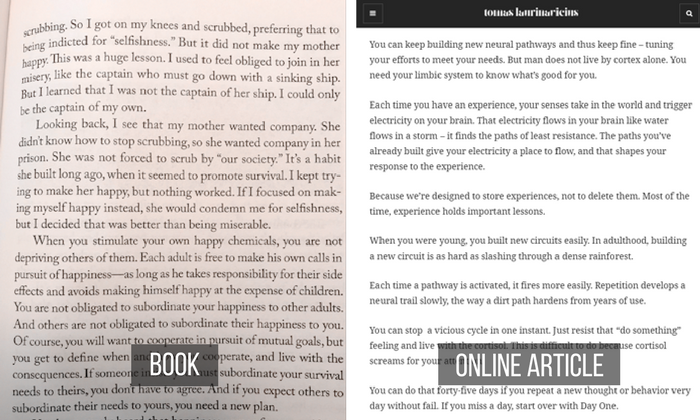
Consider the drastic difference in paragraph length between this teacher-pleasing page from Habits of a Happy Brain and this online article by Tomas Laurinaricius that reviews the same book.

Contrast Paragraphs in a book vs. online article.

The difference in paragraph structure is obvious.

But why has the paragraph changed?

The main reason for the paragraph’s evolution is the way we consume media. Print publication is no longer top dog; online publication has become the primary media for consuming written content.

We read more from our screens than from the page, which completely changes how we approach the act of reading.

When we open a book or magazine, we’re usually at home or somewhere quiet and giving it our full attention. We usually set aside some time to dive into a book or magazine.

Online, a multitude of ads and pop-up notifications threaten that undying attention, especially when we’re reading on our mobiles.

The reading habits of our audience have changed, and we must change with them or risk being ignored.

So here are the rules for writing paragraphs that will be published online. Use them to your advantage the next time you sit down to create.

The Rules of the 2017 Paragraph

Rule #1. Short Paragraphs Are Mandatory


One of the best ways to instantly turn off your audience is to present them with a big wall of text that has few breaks and little white space. A visitor who looks at such a page will click the back button faster than you can cry, “Please give it a chance!”

We have adapted to expect and prefer paragraphs that are short because they look and feel easier to read. Short paragraphs are easier to scan, and they allow readers to consume the article in bite-sized chunks, which helps maintain their focus — and this is critical in this age of distraction.

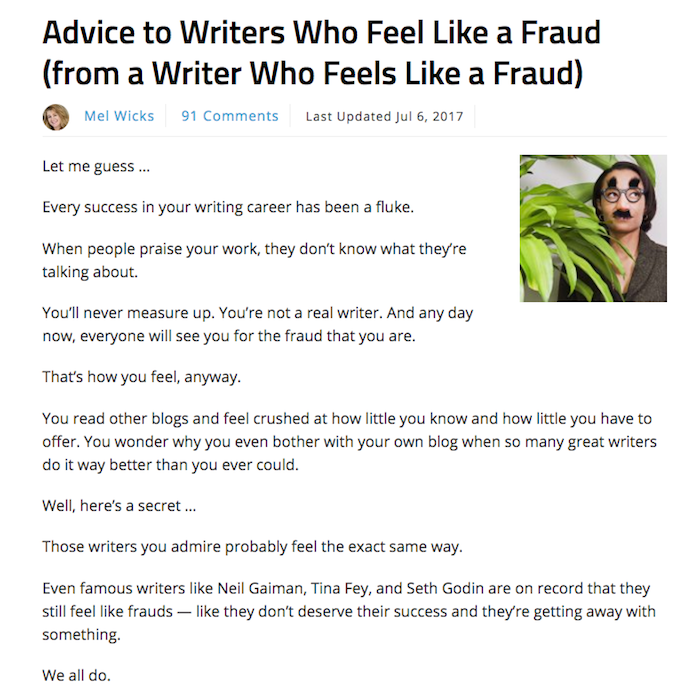
Consider, for example, the ease with which you can read the introduction to this article by Mel Wicks.

Easy to read introductions

Yes, Mel Wicks uses empathetic language and easy-to-read prose, which no doubt enhances her clarity. But you can’t ignore the sense you get just by glancing at her article that it will be an easy read.

This is the effect that short paragraphs have on readers.

In her above article, there are ten paragraphs. The longest paragraph is 42 words, and seven of them have only 12 words or less.

The 100- to 200-word paragraph standard is crippling before our eyes.

So what’s the new standard? How short do you have to be?

Well, your average paragraph should be between two and four lines. You can go over and under — some paragraphs are just one word long — but stay close to that average and you should be fine.

Rule #2. Rhythm Dictates the Next Paragraph


Rhythm is the new arbiter of words. It determines where paragraphs end and where new ones begin.

Rhythm in writing is something that’s hard to teach. It’s not an exact science and doesn’t follow hard rules. It’s something that you mostly have to feel out.

The more experienced you become as a writer, the more you’ll develop your rhythm. But in the meantime, you can follow these basic guidelines:

1. Variation

As mentioned earlier, you want to keep your paragraphs short, but that doesn’t mean every paragraph has to be under 50 words.  In fact, switching between short and long paragraphs will make your writing sing.

Here are a few noteworthy rules of thumb. You don’t have to follow these perfectly, but they’re worth remembering.

  • If you just wrote one or two paragraphs that are four lines or more, shorten the next few paragraphs.
  • If you just wrote one or two paragraphs that are only one line, lengthen your next few paragraphs.
  • If you just wrote three to four paragraphs of similar length, shorten or lengthen your next paragraph.

Too many same-sized paragraphs in a row will bore your reader. It doesn’t matter if it’s too many small paragraphs or too many long paragraphs, the effect is similar.

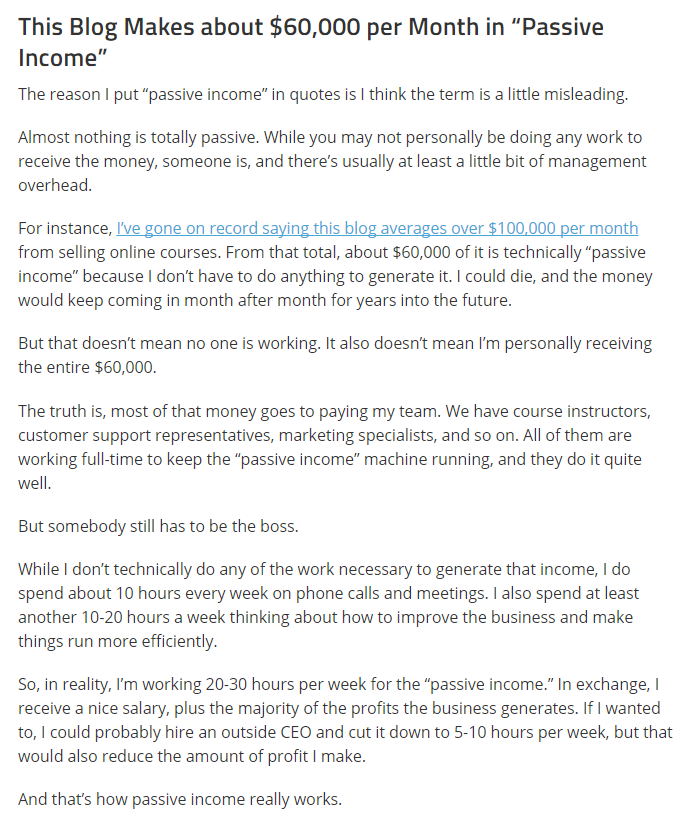
Consider this excerpt from Jon Morrow’s post on earning passive income online:

Balance short and long paragraphs.

See how he perfectly balances between short and long paragraphs?

Now imagine if the same excerpt were structured this way:

The reason I put “passive income” in quotes is I think the term is a little misleading.

Almost nothing is totally passive.

While you may not personally be doing any work to receive the money, someone is.

And there’s usually at least a little bit of management overhead.

For instance, I’ve gone on record saying this blog averages over $100,000 per month.

From that total, about $60,000 of it is technically “passive income.”

Because I don’t have to do anything to generate it.

I could die, and the money would keep coming in month after month for years into the future.

But that doesn’t mean no one is working.

It also doesn’t mean I’m personally receiving the entire $60,000.

The truth is, most of that money goes to paying my team.

Even though all of these paragraphs are short, this text feels monotonous. Too many short paragraphs make a reader feel like they’re on a rollercoaster ride with no destination — they’re moving fast but they quickly get confused about where they’re going.

Similarly bothersome is if the excerpt were structured this way:

The reason I put “passive income” in quotes is I think the term is a little misleading. Almost nothing is totally passive. While you may not personally be doing any work to receive the money, someone is, and there’s usually at least a little bit of management overhead. For instance, I’ve gone on record saying this blog averages over $100,000 per month from selling online courses.

From that total, about $60,000 of it is technically “passive income” because I don’t have to do anything to generate it. I could die, and the money would keep coming in month after month for years into the future. But that doesn’t mean no one is working. It also doesn’t mean I’m personally receiving the entire $60,000.

The truth is, most of that money goes to paying my team. We have course instructors, customer support representatives, marketing specialists, and so on. All of them are working full-time to keep the “passive income” machine running, and they do it quite well. But somebody still has to be the boss.

While I don’t technically do any of the work necessary to generate that income, I do spend about 10 hours every week on phone calls and meetings. I also spend at least another 10-20 hours a week thinking about how to improve the business and make things run more efficiently. So, in reality, I’m working 20-30 hours per week for the “passive income.” In exchange, I receive a nice salary, plus the majority of the profits the business generates.

Visually, this looks dull (and somewhat daunting) to read, and a casual reader is likely to be turned off by it.

In the original, however, each paragraph is appropriately varied, which doesn’t just look but also feels pleasant to read.

Ultimately, you want to guide your reader. And the only way to do that effectively is to recognize when your reader needs a few short paragraphs, a long one, or a bit of both.

2. Topic

While topic was once the ultimate indicator of paragraph change, it is now one of many. Topic is still critical for clarity. If you change paragraphs at a topically awkward time, the split disturbs the reader.

Take, for example, this excerpt from Liz Longacre’s article:

Blogging is a battle.

A war to get your ideas the attention they deserve.

Your enemy? The dizzying array of online distractions that devour your readers.

This battle is not for the faint of heart.

There are so many learning curves. Plugins you’ll need to install. Social networks you’ll need to employ. Marketing techniques you’ll need to try.

Imagine these paragraphs were structured like this instead …

Blogging is a battle.

A war to get your ideas the attention they deserve.

Your enemy? The dizzying array of online distractions that devour your readers.

This battle is not for the faint of heart. There are so many learning curves.

Plugins you’ll need to install. Social networks you’ll need to employ. Marketing techniques you’ll need to try.

Notice the difference in how you read the original paragraph versus the variation.

In the original, the last paragraph tactfully emphasizes the difficulty of learning how to blog. But in the variation, you take a mental pause between “There are so many learning curves” and “Plugins you’ll need to install.”

And it feels off, doesn’t it?

The last three sentences are examples of learning curves, which means they are topically linked to the phrase introducing them.

It reads even worse as follows:

This battle is not for the faint of heart.

There are so many learning curves. Plugins you’ll need to install.

Social networks you’ll need to employ. Marketing techniques you’ll need to try.

See what I mean?

Due to our topically-paragraphed past, readers still expect that topics will — for the most part — stick with each other. It still reads better that way.

Just avoid beating topics to death. Allow topics to change as they need to — which should be every few sentences.

3. Emphasis

Paragraphs of one short sentence naturally add emphasis.

This can be used to highlight ideas you want the reader to take note of, but it can also be used for dramatic effect.

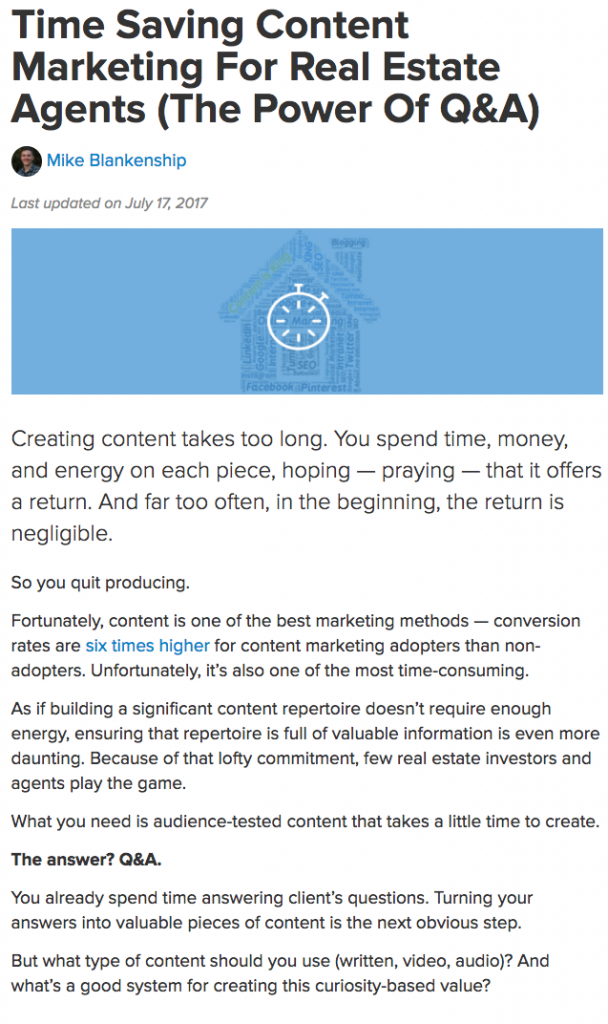
For example, check my introduction to an article for Carrot — a SaaS company that caters to real estate investors.

Use paragraph structure to guide readers.

See how the introduction guides the reader through the feelings they experience regarding content marketing with a long paragraph, and then emphasizes, “So you quit producing”?

This phase conveys a dramatic turn of events. The shortness of the paragraph emphasizes this.

The longer paragraph that precedes this phrase preps the reader for the punch. The effect wouldn’t be quite the same if it was preceded by a paragraph that was similarly short.

But you don’t always have to go from a long paragraph straight to a short paragraph to create emphasis. You can also use a gradual decline in word count and finish with your main point. This builds the reader up to the punchline.

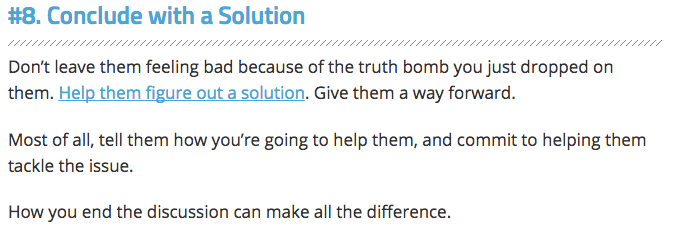
Here’s another example, taken from The Brutally Honest Guide To Being Brutally Honest. The author, Josh Tucker, decreases wordcount over three relatively short paragraphs to bring attention to his final sentence: “How you end the discussion can make all the difference.”

Use paragraph length as a tool in writing.

Think of paragraph length in the same way you think about the rest of your writing. Your word choice, sentence length and paragraph structure all have a massive impact on what your article communicates.

Ultimately, paragraph emphasis is up to the creativity of the writer. Paragraph length is simply another tool at your disposal.

Write Paragraphs for Today’s World and Readers Will Thank You

Yes, you want people to read your content.

And despite the difficulty in grabbing the attention of today’s readers, you can still turn visitors into content absorbers by crafting easy-to-read paragraphs — paragraphs that are short, rhythmic and varied.

Doing so is simply a matter of being aware of the way your paragraphs are structured. Once you’ve mastered the art of the paragraph, you’ll do much better at keeping your readers’ attention. People will crave your content and they’ll look forward to the next time you publish.

They’ll appreciate your courteous writing and — dare I say? — they’ll keep coming back for more.

About the Author: “Lover of all things communication — speaking, writing, and listening — Mike is currently the founder of MB Content where he helps businesses create significant, consistent and valuable pieces of content. You can see more of his work at Carrot, follow him on Twitter, or join his email list for entrepreneurs at Booktrep.”


from
https://smartblogger.com/how-to-write-a-paragraph/

Wednesday, August 16, 2017

I’m Back and so Is the Podcast – An Official Update

Yes, it's true. After a three-month hiatus, I'm back, and so is the podcast.

In this (somewhat abnormal) episode, I share what has happened over the last few months with my family and how that will influence what I do over the next few months and years.

Go ahead and listen.

The post I’m Back and so Is the Podcast – An Official Update appeared first on Become A Blogger by Leslie Samuel.


from
http://www.becomeablogger.com/25330/im-back-update/

Thursday, August 3, 2017

What the Heck Is Ghostwriting? (And Why You Might Want to Do It)

You want to make money as a writer, right?

You’ve told everyone on Facebook (including your weird aunt) that you’re available to write. You’ve been writing guest post after guest post to showcase your talent and get your name out there. Maybe you’ve even landed a few jobs already. (Good for you!)

But then a potential client emails you with the question, “Do you offer ghostwriting services?”

And you’re stumped. Maybe you’ve heard of ghostwriting. Maybe you have some idea what it is. Or maybe you wonder if it involves ouija boards in some way.

You don’t want to look like an idiot by emailing back to say, “Err … what do you mean?”

That sounds like a good way to send your potential client running for the hills.

Well, look no further, because I’m about to tell you everything you need to know about ghostwriting, starting with …

What Exactly IS Ghostwriting?

You might already have some hazy ideas about ghostwriting, like I did … when I first heard of ghostwriting, I thought it was just used for celebrity memoirs.

It turns out such memoirs are just the tip of the iceberg. Ghostwriting is everywhere.

So what is it?

When you ghostwrite, you let someone else put their name on your work. That is, you don’t get any credit — at all.

Typically, the person who commissions the work will own the copyright, which also means they can modify or republish the work in any way they see fit.

So why would someone hire a ghostwriter? Are they too lazy to write their own stuff?

Not necessarily. People hire ghostwriters for many different reasons, but the most common ones are:

  • Their business has grown so much that they no longer have time to write (all) their own material.
  • They have a wealth of expertise or an exciting story to tell, but they don’t enjoy writing or they’re not that good at it.

It’s nothing new, either: ghostwriting has been around, in one form or another, for centuries.

To give you more idea of what it may involve, my own ghostwriting has included:

  • Taking a rough draft, editing it heavily, and expanding on it where necessary.
  • Taking a blogger’s rough notes and transcribing them.
  • Putting together short, functional blog posts (e.g., announcing a new podcast).
  • Taking an assigned topic and very brief outline, then writing a post.
  • Writing a post based on a title and nothing more.
  • Coming up with ideas, getting them approved, then ghostwriting the posts (though this is rare!).

As you can see, ghostwriting has a spectrum from something akin to an editing relationship to writing a piece from scratch.

Of course, I’ve only ghostwritten for blogs.

Authors like Roz Morris write whole books as ghostwriters, which is a far more involved process that includes extensive interviews with the client.

But Why Would You Let Someone Else Take Credit for YOUR Writing?

Assuming you also want to build up your own brand as a writer, why might you want to ghostwrite?

After all, you won’t get any of the credit. Your name won’t appear anywhere on the piece … and you probably can’t tell anyone you wrote it.

But you have plenty of good reasons to ghostwrite. Many writers do it, and many writers love it.

Here are two main benefits:

Benefit #1: Ghostwriting Pays Exceptionally Well


One huge reason to ghostwrite is for the money. It tends to pay better than regular freelancing.

After all, having your name attached to your words is valuable for you as a writer. When you have a byline, you can use that piece of work to showcase your talent, build your reputation, and potentially attract new clients. So it’s appropriate (and standard practice) to increase your fee to compensate for the loss of these advantages.

There’s no exact rule of thumb for how much extra you should charge for ghostwriting over regular freelancing. Personally, I tend to increase my fee by about 15%–20%.

On top of that, once you’ve established a ghostwriting relationship with someone, it often results in ongoing work for you. Most people want their writing to be consistent, so it makes sense to stick to the same writer.

In other words, you have consistent work at a higher rate than usual. That’s quite a plus, isn’t it?

Benefit #2: Develop Closer Relationships with Big Names in Your Field


As a ghostwriter, you’ll normally work quite closely with your client. You may be privy to their rough notes or mind maps, or you might interview them on the phone or in person.

Chances are, you’re also focusing your ghostwriting on a particular area of expertise (especially if you’re writing for a blog).

This means that you’ve got a brilliant opportunity to get to know someone well-established in your field.

You’ll find that you get valuable insights into the “behind the scenes” of a top blog, or you get a clearer idea of how a big-name author works and thinks.

This may be eye-opening! It could give you some ideas for how best to move forward with your own business.

And as you build up closer relationships, or even friendships, with your client, they may well share your other work on social media, bringing you a lot of extra traffic. (Several of the people I ghostwrite for have supported me in that way.)

If you ever need a favor or need some advice, there’s a good chance they’ll be very happy to help.

So much of blogging success depends on getting a helping hand from other bloggers … particularly those with a large audience and a great reputation in their field. Ghostwriting brings you into close contact with exactly those people.

The Counterpoint: Why You Might NOT Want to Ghostwrite

There are a couple of big concerns that writers have about ghostwriting:

“But surely that’s not ethical?”

“But why should they benefit from my hard work?”

“But what about building my platform?”

These are real, valid concerns … and for you, they may be deal-breakers.

So let’s dig into them.

Objection #1: “You’re Helping Someone Fool Their Readers — That’s Unethical”


When you ghostwrite for someone, they pass your words off as their own.

Is that ethical?

The authors who hire ghostwriters certainly think it is! But not all writers or readers agree. Many feel that some types of ghostwriting are more ethical than others.

For instance, think about these two scenarios, which are on opposite ends of the ghostwriting spectrum:

  1. A big-name blogger hires a ghostwriter to write an ebook on their behalf. The blogger talks to the ghostwriter for an hour and provides a detailed outline. Once the ebook is complete, the big-name blogger reads it, edits it, and puts his name on it.
  2. A big-name blogger hires a ghostwriter to write an ebook on their behalf. They give the ghostwriter free rein to come up with the topic and outline, and they don’t supply any help. When it’s done, the blogger puts his name on it without giving it a second look.

Personally, as a reader, I’d feel comfortable with situation #1. The thoughts in the ebook belong to the blogger; the ghostwriter has helped shape those.

Situation #2, however, seems a lot thornier. As a reader, I’d feel cheated by that. I’m buying the ebook because I want the blogger’s expertise … not that of a ghostwriter I don’t know.

If you’re thinking of ghostwriting, you have to make up your own mind about what is — and isn’t — ethical. Where would you personally draw the line as a ghostwriter, if at all?

For more thoughts on the rights and wrongs of ghostwriting, check out Patty Podnar’s post Is Ghostwriting Ethical?

Amanda Montell’s Your Favorite Influencers Aren’t Writing Their Own Content—These Women Are is also quite eye-opening about some of the less ethical practices in the ghostwriting world.

Objection #2: “It’s Too Painful Watching Someone Else Get Praised for YOUR Work”


It may sound silly, but not getting recognition for your writing can be quite painful — unbearable to some.

I have to admit that, as a writer, it can sometimes sting a little to see a blogger receive lots of lovely praise for a post that I wrote every word of. And I’m not alone; many writers find themselves missing the attention and craving the recognition.

It’s no fun watching someone bask in glory that should be yours.

But think of it this way: All that praise is a sign you did a great job. You can be proud of that, and you can feel confident you’ll get hired again!

Also, as ghostwriter Roz Morris points out in an interview with whitefox, it’s not just ghostwriters who go unnoticed by readers:

There are many unsung heroes in the creative industries, and ghostwriters are only one of them. Editors can also make a huge difference to a book and are rarely credited.

So, if you can’t stand watching someone else take the praise, that’s okay. Many writers feel that way. But maybe we should also keep things in perspective.

Sidenote: If you think ghostwriting sounds like a perfect fit for you, and you’re a reasonably experienced writer, I recommend Roz’s course, Become a Ghost-Writer.

Objection #3: “Ghostwriting Keeps You from Building Your Platform”


Even if you’re okay with someone else getting the praise, you may still oppose the idea of letting them take credit.

Some writers feel that, for long-term success, you need to take credit for every word you write and create an impressive body of work with your name on it. They believe that ghostwriting is essentially a waste of time.

After all, when you’ve got a bio (or at least your name) on every blog post you write, each of those posts helps raise your profile. You’ll be bringing in new readers and potentially new clients through your work … without any additional marketing.

This is essentially the argument that Demian Farnworth puts forward in The Brutally Honest Truth About Ghostwriting:

The first thing every writer should ask is this: What do you want to accomplish as a writer? Is building a personal and visible platform important to you? Will it help you in the long run? If you have to ghostwrite to make ends meet, fine. But beat a hasty path out of the business as soon as possible. It’s your turn to run the show.

I certainly think it’s worth putting some serious thought into how best to make ghostwriting work for you. It might be that you want to solely focus on your own platform (heck, you might even hire ghostwriters of your own, some day down the line!)

But there’s no shame in taking ghostwriting jobs to generate a steady income while you build your platform. It doesn’t have to be one or the other. You can do both at the same time.

Ghostwriting takes some focus away, but that doesn’t mean it’s not worth doing.

ghostwriting infographic

Will You Give Ghostwriting a Try?

Ultimately, ghostwriting can be a little divisive.

Some writers feel — passionately — that readers deserve to know exactly who wrote the words they’re reading. Others feel building your platform is too important to let someone else take credit.

But ghostwriting is a good way to make money as a writer.

And it doesn’t mean your platform is off the table. You can ghostwrite and have a writing career under your own name. Many writers, including me, simply use ghostwriting as a way to supplement or support their writing passions.

Personally, I think it’s worth it.

Only you can decide whether it’s right for you.

About the Author: Ali Luke blogs about the art, craft, and business of writing at Aliventures. If you’re interested in going further with ghostwriting or any type of freelance writing, check out her epic post: Freelance Writing: Ten Steps, Tons of Resources.


from
https://smartblogger.com/ghostwriting/

Thursday, July 20, 2017

The Brutally Honest Guide to Being Brutally Honest

It’s scary, isn’t it?

Having to tell a truth to someone who may not want to hear it.

Whether you have to tell a friend they’ve been betrayed, inform a client that their ideas suck, or write a blog post to burst your reader’s bubble, hard truths can feel almost as painful to deliver as they are to receive.

Because just the thought of hurting someone is scary. You don’t want that.

And you don’t know how they’ll react. They might think you’re a jerk and cut all ties with you. You don’t want that either.

So sometimes you obfuscate the truth to spare them the pain of hearing it. Sometimes you even keep it to yourself or tell a white lie.

Well, I have to tell you something, and you may not like to hear it. But if you struggle with the art of being frank, you need to hear this. It will make you a better person, a better communicator and a better blogger.

So here it is …

You’re a coward.

If you can’t be brutally honest with people, especially when you know it’s in their best interest, you’re a coward.

Why You Can’t Be a Coward When It Comes to Hard Truths

You’re not doing anyone a favor by withholding a truth from them, even if it’s difficult for them to hear.

The only person you’re protecting is yourself. Because you’re afraid of the consequences to you.

But it’s not about you.

Being honest is about making sure your audience has the information they need to make good decisions. That includes information they may not like.

You may convince yourself it’s “nicer” to hide or obfuscate things that are difficult for them to hear, but it’s not.

Ignorance doesn’t lead to bliss, it leads to bad decision-making. There’s nothing “nice” about that.

And as a blogger trying to help your readers, honesty is that much more important.

Because readers rely on your expertise and your candor.  They rely on you to set them straight when they’re headed the wrong way. They rely on you to guide them in the right direction.

You may fear you’ll lose readers when you tell them a hard truth, but withholding it is far riskier. Because it will hurt your credibility in the long run.

When you’re honest at all times, whether in your writing or in your personal life, people will know what to expect from you. And when they need the truth, you’re the one they will come to.

Yes, you may lose some readers along the way, but you’ll gain the trust and respect of so many more.

The Big Mistake People Make While Being Brutally Honest

Brutal honesty is not about being cruel, rude, shocking, or harsh. That’s not brutal honesty. It’s just brutal.

If that’s what you’re going for, you’re doing it wrong.

Maybe that seems obvious to you, but many people mistake brutal honesty for honest brutality. You’ve probably experienced more than your share. So if it’s that obvious, why do so many people make this mistake?

Because it’s not obvious. In fact, it’s almost counterintuitive.

Many people think that the point of brutal honesty is to shock someone into hearing you. They think that the point is to be so harsh that the other person can’t help but hear the truth.

But that’s not really how it works. Treating people harshly will only make them less receptive to what you have to say, not more.

The point of brutal honesty is to be completely honest and let the truth speak for itself. It’s about not holding anything back — about not telling white lies to make a person feel better, or withholding information they might find hurtful. Those are things we do on a regular basis, and the point of brutal honesty is to stop doing that.

You see, the emphasis in brutal honesty should be on the honesty, not on the brutality.

It is the truth that you need to deliver, and not your delivery itself, that needs to be brutally unrestrained.

Of course, the problem is that being brutally honest isn’t just hard to do—it’s hard to do well. That’s because it’s not just about what you say; it’s also about why, when, and how.

brutal honesty is not about being cruel

3 Common Situations That Call for Brutal Honesty

Honesty is always a good policy, but not every situation calls for brutal honesty. So how do you know when it’s time to hold nothing back?

At the end of the day, it’s about assessing the situation, being clear about your purpose, and using your judgment.

But here are three common scenarios that often call for brutal truth:

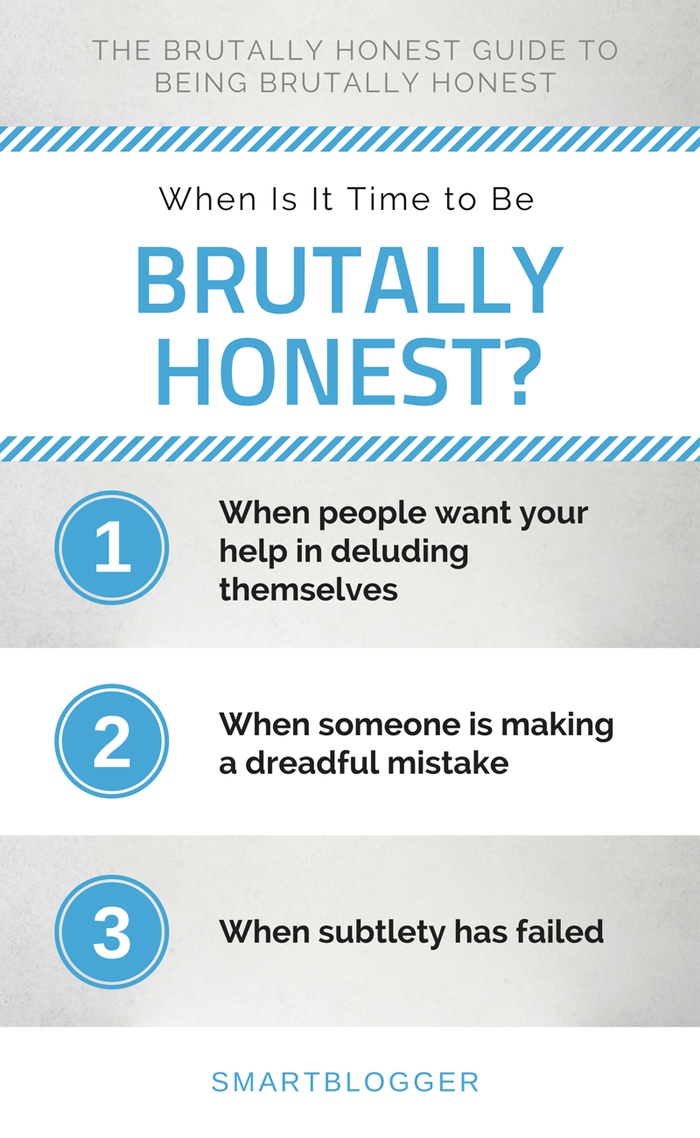
#1. When They Want Your Help in Deluding Themselves


Whenever someone comes to you to confirm their delusions, you need to do the exact opposite.

For example, many bloggers might love to hear that all they need to do to make money is write posts and slap ads on them. They might want to hear that riches are right around the corner, even if they only just got started. But what they need to hear is that there’s no such thing as easy success, that it takes time, and that they must adjust their expectations.

Trying to sugar-coat this reality wouldn’t help them.

#2. When They’re Making a Dreadful Mistake


You wouldn’t let a friend walk blindly into traffic without reaching out a hand to pull them back. Hell, you wouldn’t even be so inconsiderate to a stranger.

So why would you let them make a harmful decision without trying to save them from it?

Sure, walking into traffic is likely to cause them serious harm — but so is making a decision that would ruin their career, blow their life savings, or land them in jail.

If they’re about to make a big mistake — or even if they’ve already made the mistake — your willingness to be brutally honest with them might just be the thing that saves them from future pain.

#3. When Subtlety Has Failed


How do you know when brutal honesty is called for?

When nothing else has worked. By all means, try a subtler, gentler approach first—but when nothing seems to get through to them, it’s time to take off the kid gloves and tell them what they need to hear, without holding back.

Situations That Call for Brutal Honesty

These aren’t the only circumstances which call for brutal honesty, but they are frequent ones, and they have two basic principles in common: the hearer badly needs to be told the truth, and yet it is very difficult for them to discover or receive it.

And that’s where you come in.

8 Steps to Being Brutally Honest Without Crushing Anyone’s Spirit

Great. So you understand what brutal honesty is, and what it is not. You know why brutal honesty is sometimes necessary, and when it is appropriate.

Now comes the hard part: How do you actually do it?

Here is an eight-step process to help you deliver that hard truth.

#1. Be Brutally Honest with Yourself


Brutal honesty begins with yourself. If you’re hesitant and tend to shy away from bluntly honest conversations, then the first step is to acknowledge why you hesitate.

Are you afraid of offending people? Ask yourself whether allowing them to continue on a harmful path is kinder than having an uncomfortable conversation with them.

Are you afraid that people will get mad at you, and perhaps cut ties with you? Do you worry about losing readers, subscribers, or clients?

As I mentioned above, ask yourself whether they’re better off not knowing, or whether you just don’t want to be the one to tell them.

Remind yourself that this is about doing what is best for them, not what is easiest on you.

#2. Check Your Motives


In the first step, you checked your motives for not wanting to be brutally honest with someone. In this step, flip that around—ask yourself if being honest with them is really about their well-being, or if it’s about you.

Yeah, that happens, too.

If it’s more about your desire to speak your mind than about what they need to hear, you’re likely to end up falling into that trap of being more brutal than honest.

So ask yourself this classic trio of questions about your message:

  1. Is it true?
  2. Is it necessary?
  3. Is it kind (or helpful)?

If the answer to all three isn’t yes, it’s time to reevaluate.

#3. Be More Honest than Brutal


Remember, the point is always honesty, not brutality.

You can tell the brutal truth without being brutal yourself. Let the truth be merciless on its own. It is hard enough for many to hear and face. So don’t add to it. Be kind.

Let me say that again: Tell them the whole truth, no matter how brutal it may be, but do it with kindness and empathy.

Be more honest than brutal

#4. Prepare Them for What’s Coming


Don’t just launch straight into the tough love. Give them the opportunity to prepare themselves for it.

Explain that you care about them. Explain that you have to tell them something you believe they need to hear, and prepare them for the degree of honesty they’re about to get from you.

For an example, look no further than what I did in the intro to this post:

Well, I have to tell you something, and you may not like to hear it. But if you struggle with the art of being frank, you need to hear this.

It doesn’t take much. Just a heads-up about what’s coming, so that your audience can put themselves in the right frame of mind for it. Blindsiding them won’t make them more receptive to hearing a brutal truth.

#5. Reveal Your Intentions


Why are you telling them this difficult truth? What do you want to come of it? How is hearing it worthwhile to them?

Understanding what they have to gain from it will make the other person much more receptive to the harsh truth. It will be much easier for them to hear and accept if they genuinely believe that you’re trying to help them.

So take a moment to tell them why you think what you’re about to tell them is the best thing for them.

Again, you can see how I did that in this post. Before I hit you with the brutal truth, I first told you how I thought it would benefit you:

… if you struggle with the art of being frank, you need to hear this. It will make you a better person, a better communicator and a better blogger.

And then, with the benefit still fresh in your mind, I took off the gloves and told you the blunt truth.

#6. Be Short and Sweet


It’s never a good idea to beat a dead horse. As a writer, it’s a great way to get people to stop reading.

But this is even more true when your reader is taking a beating, too. Being told a hard truth is never fun. Sometimes it’s necessary. But having it thrown in your face over and over is something few people react well to.

So get to the point. Make it clearly and succinctly, and move on.

Anything more, and you’re heading back toward being more brutal than honest.

You’re a coward.

If you can’t be brutally honest with people, especially when you know it’s in their best interest, you’re a coward.

Notice how I don’t dwell on the cowardice for too long? Instead, I quickly move on to explaining the reasons behind my remarks.

Keep brutal honesty short and sweet

#7. Stick to the Facts


This is easier for some topics than it is for others. Sometimes the facts are clear, measurable, and objective. You’ve got actual data, research — cold, hard facts. Other times, the issue at hand is a subjective assessment.

But even when the subject matter is wholly subjective, you can keep the discussion focused on the relevant issues.

Be as objective as you can, given the subject matter. Avoid emotional observations. Focus on actions — things the other person has done, or things they need to do — rather than on character and personality.

Most of all, focus on problems that can be solved.

Again, you can see that in my approach to this post. I didn’t dwell on negatives or beat you over the head with character flaws. As you can see below, I focused on the facts — which, in this case, meant explaining why I had just called you a coward by emphasizing things I knew you’d agree with:

“Being honest is about making sure your audience has the information they need to make good decisions. That includes information they may not like.

You may convince yourself it’s “nicer” to hide or obfuscate things that are difficult for them to hear, but it’s not.

Ignorance doesn’t lead to bliss, it leads to bad decision-making. There’s nothing “nice” about that.”

#8. Conclude with a Solution


Don’t leave them feeling bad because of the truth bomb you just dropped on them. Help them figure out a solution. Give them a way forward.

Most of all, tell them how you’re going to help them, and commit to helping them tackle the issue.

How you end the discussion can make all the difference.

Do you want them to feel defeated, beat down, and discouraged? Or do you want them to feel hopeful that there are concrete ways that they can address the issue?

Imagine if I ended this post after calling you a coward, without offering any advice on how to deliver brutal truths. That would make the overall message feel far less benevolent and far more antagonistic, wouldn’t it?

Have the Courage to Tell the Unvarnished Truth and You’ll Win People’s Respect

Telling someone a hard truth can be scary.

Because you don’t know how people will react.

And I won’t lie. Some people won’t like it. Even if you take all the right steps, you may still offend them, and you may still lose them.

But you’ll also gain others who recognize the value of someone they can trust to be honest — the type of people who may never have paid attention to you while you were busy telling everyone what they wanted to hear.

And as you develop a reputation as a person who tells it straight, you will gain people’s respect. You will gain credibility and authority. People will seek out your advice, value your perspective, and appreciate your honesty.

And you will help people—far more than when you were telling them whatever they wanted to hear.

And isn’t that the point?

About the Author: Josh Tucker is the founder of The New Progressive. As a race and social justice writer, he’s no stranger to telling hard truths.


from
https://smartblogger.com/brutally-honest/

Thursday, July 6, 2017

Advice to Writers Who Feel Like a Fraud (from a Writer Who Feels Like a Fraud)

Let me guess …

Every success in your writing career has been a fluke.

When people praise your work, they don’t know what they’re talking about.

You’ll never measure up. You’re not a real writer. And any day now, everyone will see you for the fraud that you are.

That’s how you feel, anyway.

You read other blogs and feel crushed at how little you know and how little you have to offer. You wonder why you even bother with your own blog when so many great writers do it way better than you ever could.

Well, here’s a secret …

Those writers you admire probably feel the exact same way.

Even famous writers like Neil Gaiman, Tina Fey, and Seth Godin are on record that they still feel like frauds — like they don’t deserve their success and they’re getting away with something.

We all do.

The Voice Inside My Head That Tells Me I’m Unworthy

I have been a freelance writer for over three years, but I still feel I have no right to claim that title — writer.

I have a nagging voice inside my head that constantly reminds me of my unworthiness. It tells me to give up before I’m laughed off the Internet. That I’ll never compare to other writers — the real ones.

It provides a symphony of thoughts like:

“Who do you think you are?”

“Why would anyone care what you have to say?”

“Sooner or later, they’ll find out you have no clue what you’re doing.”

I call this voice the “Imp.” Her full name is Imposter Syndrome, and chances are you’ve already met. If you’ve ever had that dread of being outed as a fraud because you don’t stack up to other writers, you’ve experienced Imposter Syndrome, and you have an Imp of your own.

Imposter Syndrome is common across industries, but writers are especially susceptible.

Why is that?

Why Do We Feel Like Frauds All the Frickin’ Time?

Writing is a peculiar profession.

One thing that sets us apart is that we work in isolation.

That means nobody’s around  to tell us we’re doing a great job until we put it out there for total strangers to judge. We’ll often work for a while on a project with no direct feedback, so it’s easy to start second-guessing our ability.

We have nobody to discuss our doubts with, so we are locked into internal conversations, which makes the Imp’s voice sound all the louder.

Working in isolation also means we don’t have any peers around to compare ourselves with, which leads us to compare ourselves with industry giants. No wonder we feel like we don’t measure up!

This also leads to us to create standards for ourselves that don’t exist. After all, you don’t see the time and effort other writers put in. You just see the result. That blog post that seems so effortless could be the result of weeks of work. But when you fail to churn out a perfect first draft, it means you’re an amateur.

The writing profession becomes even more dangerous when you step outside your comfort zone. You may have pitched an article to a large publication, and to your horror, they actually said yes. Then the insecurity takes hold and the fear of being exposed as an imposter rears its familiar head.

Sigh …

So are we doomed to deal with this nagging voice throughout our profession?

I’ll be honest; you may never fully get rid of it.

But you can learn to live with it.

How to Beat Imposter Syndrome: 4 Tips from a Writer Who Knows How You Feel

The first step on your road to recovery is to be aware that isolation, new challenges, and pointless comparisons are common causes of Imposter Syndrome. You may not always be able to avoid them, but if you are mindful of their effect, it will help you wrestle your Imp to the ground when needed.

And here’s how to do it.

#1. End the Isolation and Surround Yourself with Writers


The first step to beating Imposter Syndrome is to tackle one of its main causes: isolation.

You need to make friends with other writers who are at the same stage in their careers. You need to have people around you who understand you, who make you feel part of the writing community instead of an intruder.

Here are a few ways to meet other writers:

  • Join online writing communities (forums, Facebook groups, etc.)
  • Find local writing meetups on meetup.com.
  • Attend writing or blogging conferences.

Meet writers who are your peers, see who you get along with, and then join or start a mastermind group. Get together every week with a small group of people (around 4–6) and discuss what you’ve been up to and what’s been on your mind.

Share your fears and frustrations, and find comfort and reassurance in your similar experiences. You’ll inspire and encourage each other to grow as writers.

And as you grow, give back to the community by mentoring less experienced writers. Not only will you be helping others, your confidence will strengthen as you prove to yourself you do know what you’re doing and people do care what you have to say.

It’s rewarding and empowering at the same time.

Imposter Syndrome Advice #1

#2. Prepare for Failure AND Success (Because Both Can Be Crippling)


The Imp comes with a cruel twist. It won’t just berate you for failures; it will berate you for successes as well.

When a pitch is rejected or an article bombs, your Imp will use it to convince you that you don’t have what it takes.  Having a few failures in a row can make you want to curl up in a ball of despair.

On the other hand, when your writing is successful and gets glowing responses, your Imp will convince you it was a fluke. It will make you feel like you’ve now set expectations you’ll never be able to meet again.

The effect is the same. You procrastinate.

Because no idea feels good enough. You never feel prepared enough. And nothing you write feels like it stacks up.

You get stuck over-analyzing and don’t start anything new.

But the trick to beating your Imp is to keep yourself busy. Because the more you have on your mind, the less time you have to listen to that debilitating inner voice.

So prepare for these situations by creating an action plan. Have a list of tasks ready for whenever they come up, so you won’t have time to drive yourself crazy.

For example, when a pitch is rejected, you might make a point to ask for feedback, find different sites to pitch, or come up with 20 new headlines.

When a post takes off, you might make a point to read all the comments, identify what connected with readers, and see if you can find ideas for a follow-up post.

Whatever you do, stay active, and end each plan with you writing your next post.

Imposter Syndrome Advice #2

#3. Log Your Victories to Reinforce Your Self-Esteem


Most of us have an instinct to devalue our talent. When a post does well, we think we got lucky. When someone compliments our work, we shrug it off.

But those are terrible habits.

You need to take responsibility for your victories.

When a post does well, you did that. When you get a compliment, you earned that.

And you should never forget it.

So log your victories in a “nice things” file. Log accomplishments big and small. Log every compliment you receive. Print them out or store them in Evernote.

Then read them on a regular basis. It will banish your Imp and reinforce your belief that you have talent. It will reinforce your belief that people value your work. Plus, it just feels good.

It’s okay to bask in your own glory from time to time.

Imposter Syndrome Advice #3

#4. Remember That Nobody Expects You to Be Perfect (Except You)


As writers, we put ourselves out there as experts, which can feel intimidating.

You feel pressured to put forth a veneer of perfection. You don’t want to show the cracks in your knowledge, as that would show everyone you’re not an expert at all.

Because you don’t feel like one. You’re certainly not as much of an expert as those other guys, right? Because they know more than you?

So what if someone asks a question you don’t have the answer to?  What if your post doesn’t include everything an expert would know? What if everyone realizes you don’t know everything?

Well, relax. Because readers aren’t looking for the holes and imperfections in your posts. They’re more interested in what you do know than what you don’t. The only one who’s worried about the latter is you.

Readers only care whether your knowledge and experience can help them reach their goals. You may not know as much as that other expert, but if you can do that, you’re expert enough for them.

Remember that.

Imposter Syndrome Advice #4

You Are Not a Fraud, You Are a Writer

Your successes aren’t flukes.

You deserve all the praise you get.

And you are a writer — a real one.

So it’s time you finally convince yourself.

It’s time you fight back, wrestle your Imp to the ground and say, “Enough! I am smart, I am brave, and I earned everything I’ve worked for. I AM NOT A FRAUD!”

I’m right by your side, my fellow writer friend.  Let’s do this together.

Let’s tear down the walls of isolation and surround ourselves with writers. Let’s stop feeling intimidated by success. Let’s stop expecting nothing but perfection from ourselves.

Let’s promise to keep writing no matter what, and let’s take responsibility for all the victories along the way.

Are you with me?

About the Author: Mel Wicks is a freelance copywriter and content marketer. Download her free bonus ‘7 Golden Writing Rules — A No-Fluff, Step-by-Step Guide to Writing Quality Blog Posts’ and be one of the first to hear when her new blog, The Craft of Copywriting, goes live in August 2017.


from
https://smartblogger.com/imposter-syndrome/